How to draw acanthus leaves
There is a plant called acanthus growing in Mediterranean gardens, and the leaf we draw is not it. Ours was stylised onto the Corinthian capital in ancient Greece, carried onward through Roman friezes and scrollwork, and redrawn in every century since. Learn to build one and most of classical ornament opens up, because nearly all of it is this single form turned, folded, overlapped and repeated.
What to learn, and in what order
I have written the step by step out in full here, free, every stage of it plus the four mistakes I see most often: How to Draw Acanthus Leaves, Step by Step. Read that if you want to draw a leaf this afternoon. This page is for the other question.
That other question is the one I am asked most often, and it is fair: there are a lot of acanthus courses here, and it is not obvious from the titles which one you need. So here is how I would take them, and what you would be able to draw at the end of each stage.
Begin with How to Draw an Acanthus Leaf: Beginner Course (1h 33m). It builds the leaf out of a framework rather than teaching you to copy an outline, which is the difference between drawing one leaf and being able to draw any leaf. By the end you can set down a straight one, a curved one and one seen from the side without a reference propped up in front of you. Ordinary pencil control is enough to start.
Then the four that give a leaf its character, one subject each and none of them dependent on the others. Refining Acanthus (1h 22m) is edges and cuts, and why one leaf reads as graceful and another reads as machine made. Shading Acanthus (1h 17m) is light: where a form shadow belongs and where a cast shadow does. Layering Acanthus (1h 2m) is deciding which leaf sits in front, and the four kinds of overlap that make the decision visible. Acanthus in Motion (1h 26m) is why one leaf looks alive and another looks pinned to a board. Take whichever is annoying you most.
After that it stops being about a leaf and becomes about a design.Acanthus Design Course: Leaves, Lobes and Curves (2h 26m) attaches the leaf to scrolling stems and arranges several of them into something balanced, which is the ground every border and flourish is built on. Advanced Acanthus Scrollwork and Composition (5h 35m) is the long one: folded leaves, ornamental knots, and full vertical and horizontal panels. It assumes you already have curves behind you, so do not make it your first.
Three more sit slightly apart and can be taken whenever you fancy them. Acanthus Rosette (1h 28m) builds a symmetrical rosette on simple geometry, and it is the one here that asks for a compass. Colouring Acanthus (2h 5m) reads a reference, finds the light and paints an acanthus scroll in acrylics. Watercolour Acanthus Motif (1h 34m) does that work in watercolour instead, with washes and soft edges.
What you need to own is short. A pencil, a soft eraser, a fineliner, a ruler and smooth paper will carry you through every drawing course on this page. Add a compass for the rosette, acrylics and brushes for the colouring one, and watercolours and watercolour paper for the last. No tablet, no software, nothing to subscribe to.
And the honest difference between the free guide and a course: the guide is the method in writing, and it really is enough to draw a leaf with. The courses are me drawing, at the speed I actually draw, with the hesitations and corrections left in, and each one carries files to download and work over, a manual or practice sheets or the reference I painted from. All of them together come to 19h 48m, which is not a weekend. Take one, use it, come back for the next when a drawing tells you what is missing.
Every acanthus course, in the order I would take them
The order above, laid out with what each one costs and how long it runs. Every course is self paced, yours for good once bought, and watched in your browser whenever it suits you.
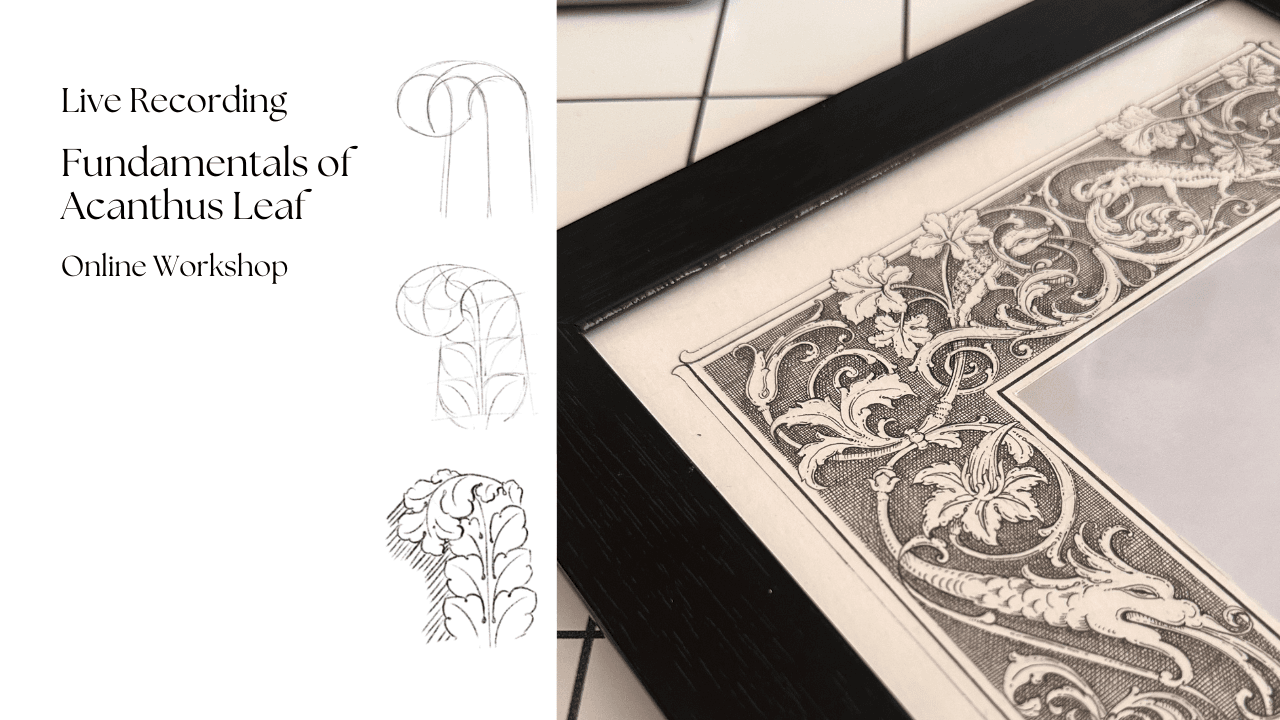
How to Draw an Acanthus Leaf: Beginner Course
Learn how to construct acanthus leaves from simple frameworks. This workshop covers straight, curved and side-view forms while focusing on rhythm, subdivision and natural flow.
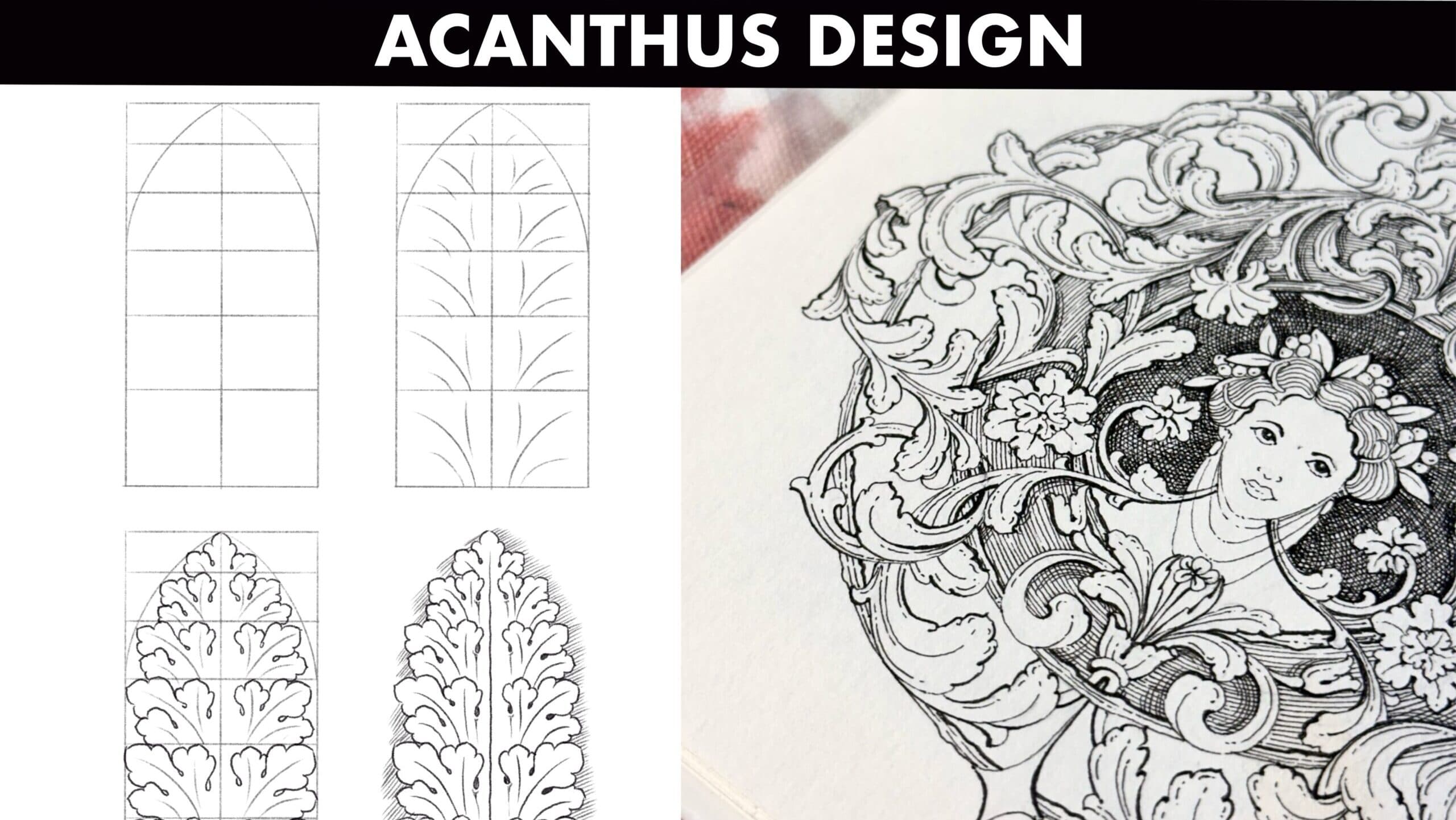
Acanthus Design Course: Leaves, Lobes and Curves
Build a strong foundation in acanthus design. You will break the leaf into simple shapes, study lobes and curves, and learn how to arrange acanthus forms for ornamental compositions.
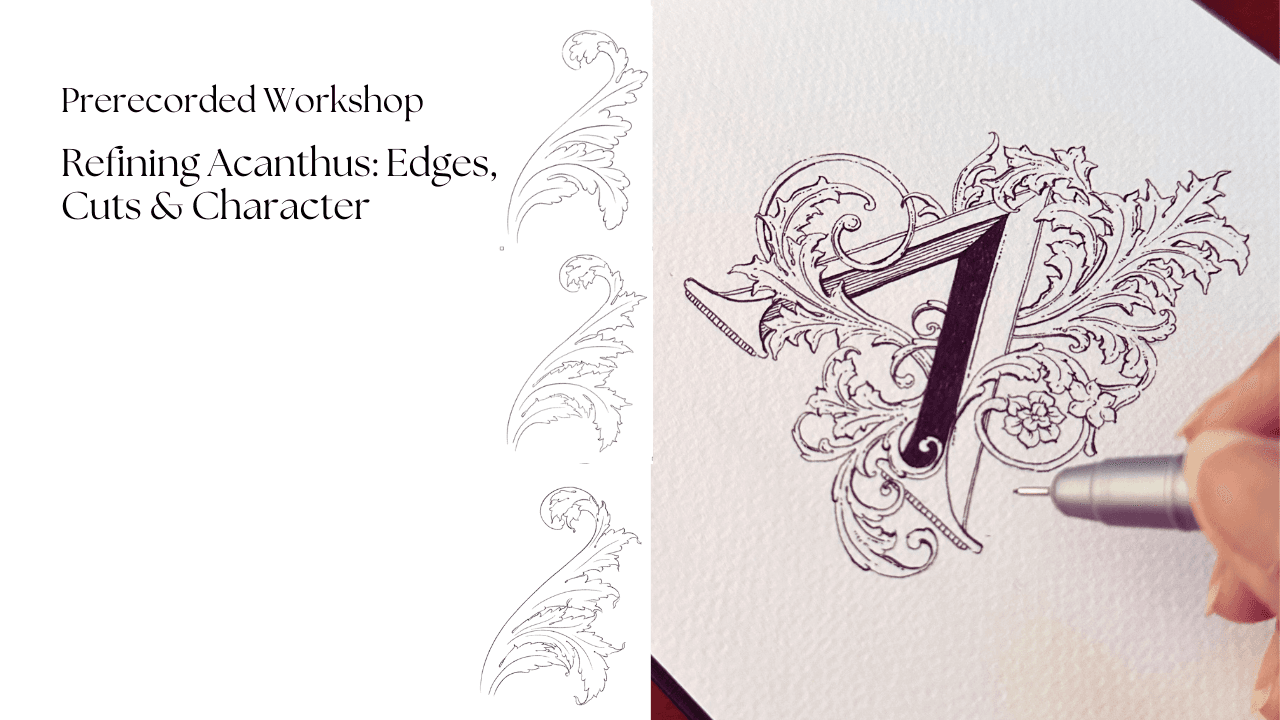
Refining Acanthus: Edges, Cuts & Character
This workshop is perfect for artists who want to deepen their understanding of ornamental design and improve the quality of their acanthus leaves. Whether you're a beginner exploring ornamental art for the first time or
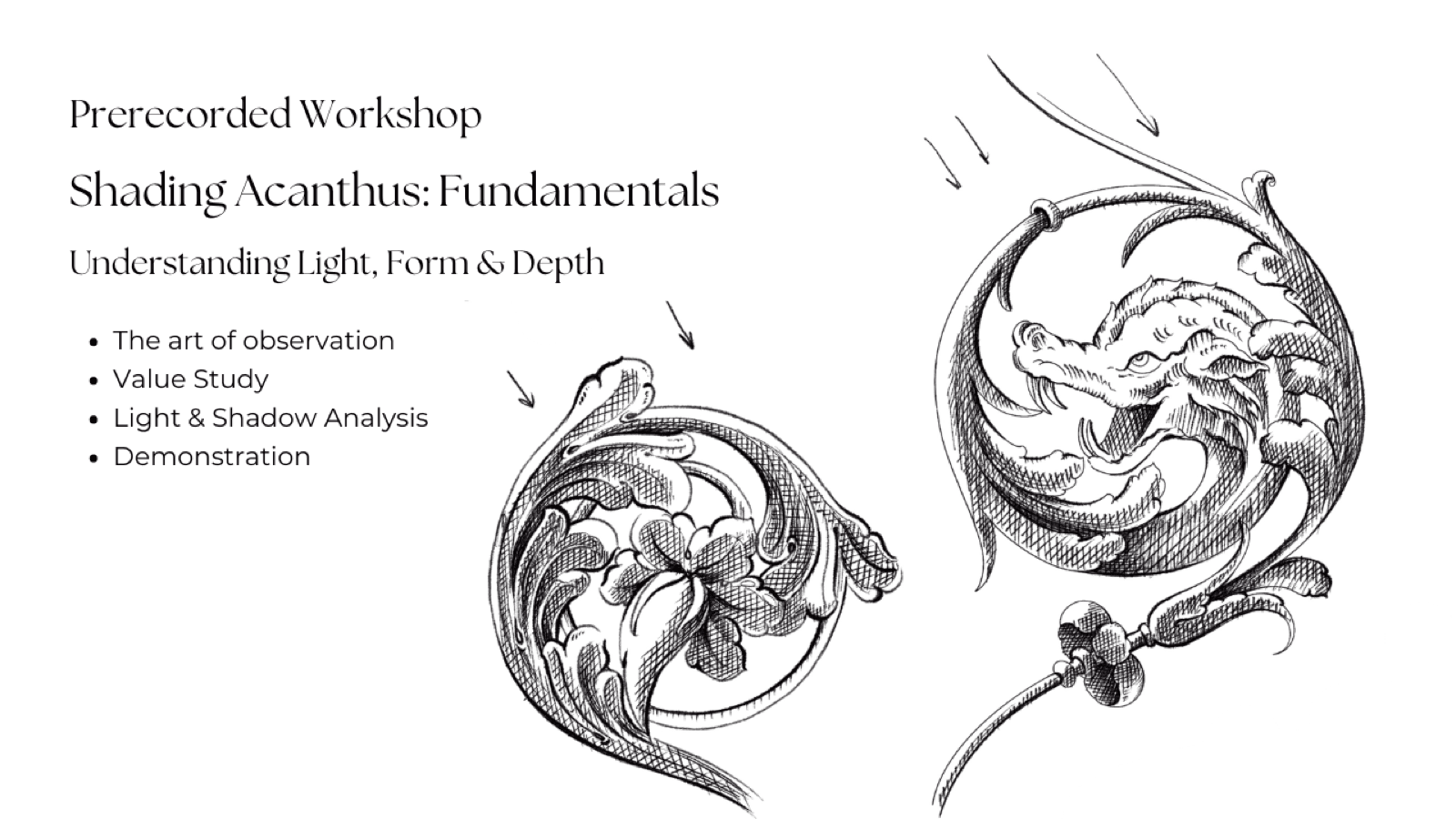
Shading Acanthus: Fundamentals
Learn to see light and form before you shade, and give your acanthus leaves real depth and dimension.
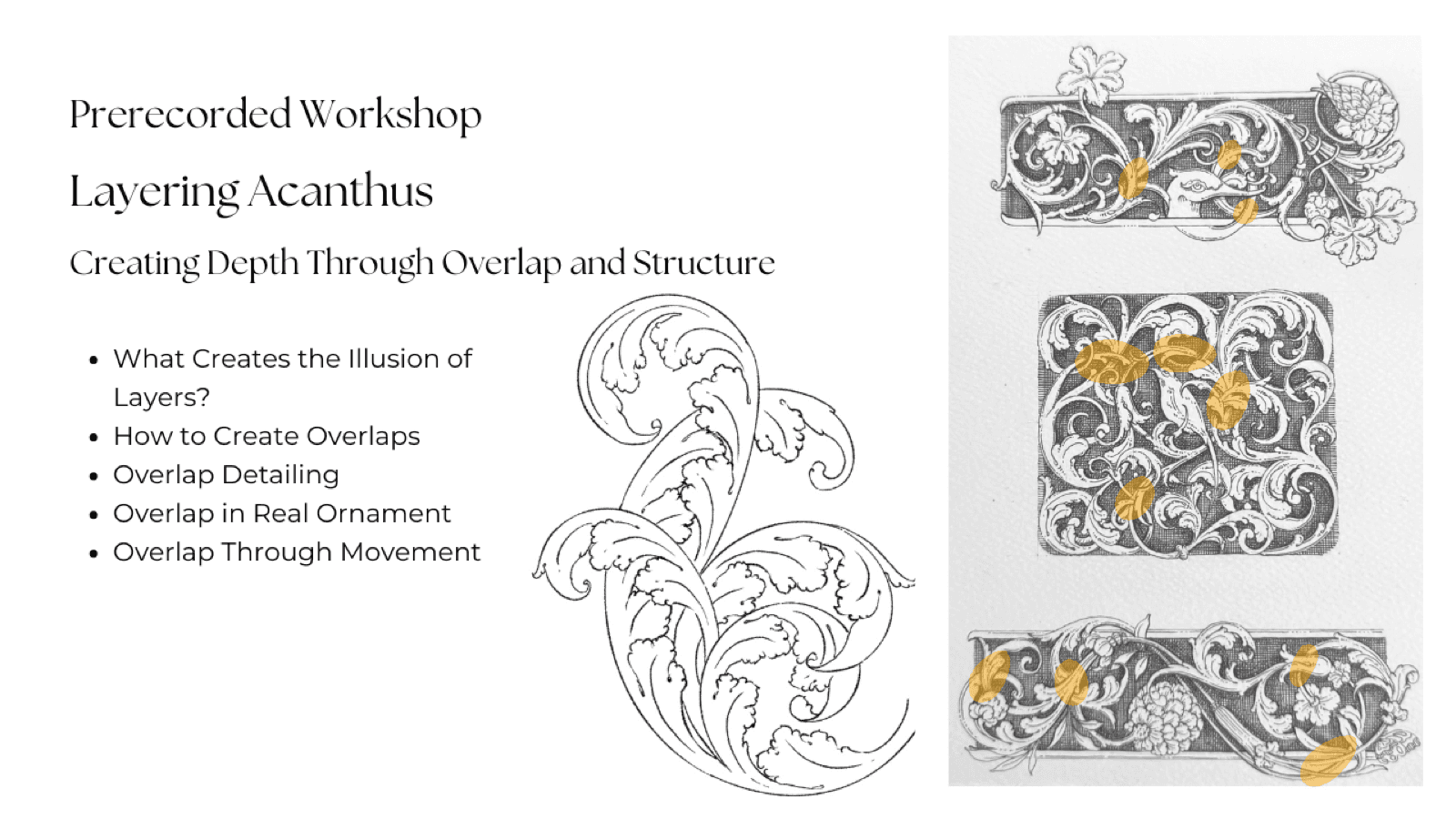
Layering Acanthus
Learn to decide which leaf sits in front, so an arrangement reads with real depth instead of going flat.
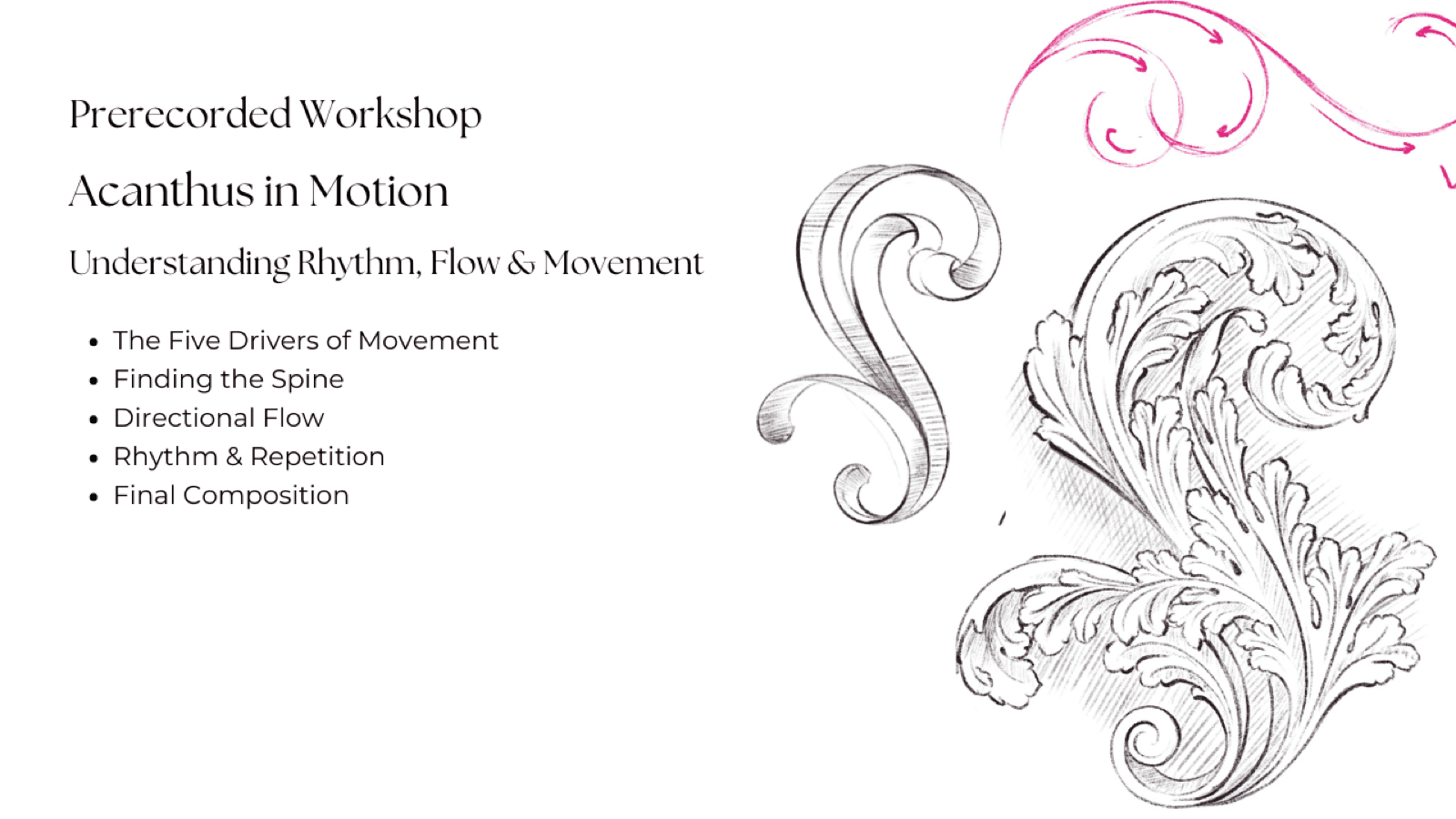
Acanthus in Motion
Learn to see what carries movement in an acanthus, and set it deliberately before you draw a single lobe.
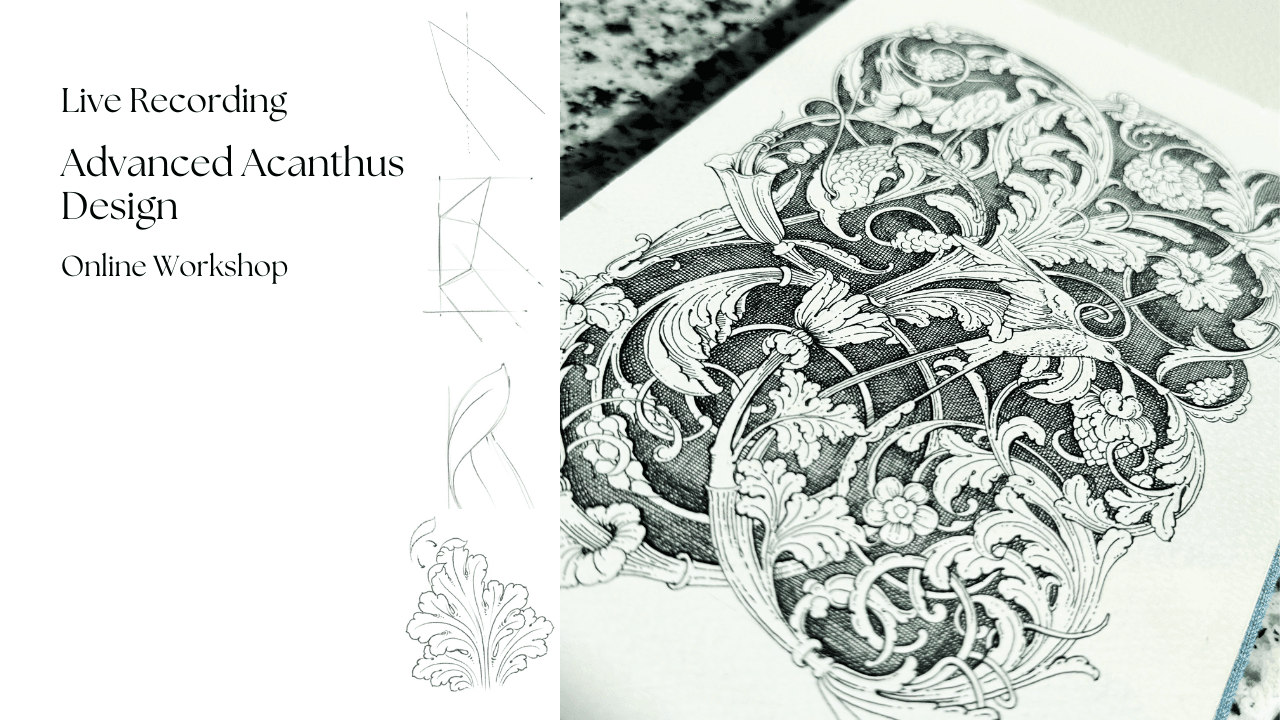
Advanced Acanthus Scrollwork and Composition
Deepen your acanthus practice with more complex ornamental compositions. This workshop covers straight, curved and folded leaves, knots, shading, depth and flow.
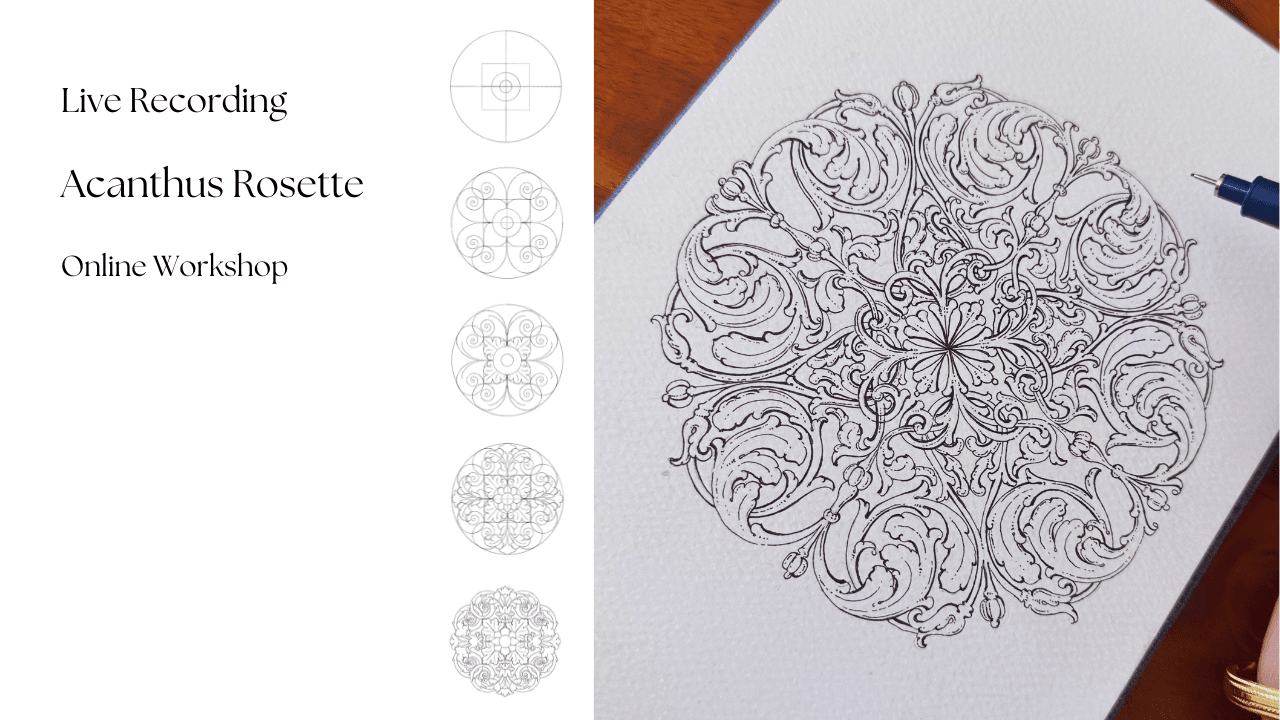
Acanthus Rosette in Ornamental Art
Learn to draw an acanthus rosette by combining simple geometry with flowing leaf forms. This workshop covers structure, symmetry, rhythm and refined ornamental detail.
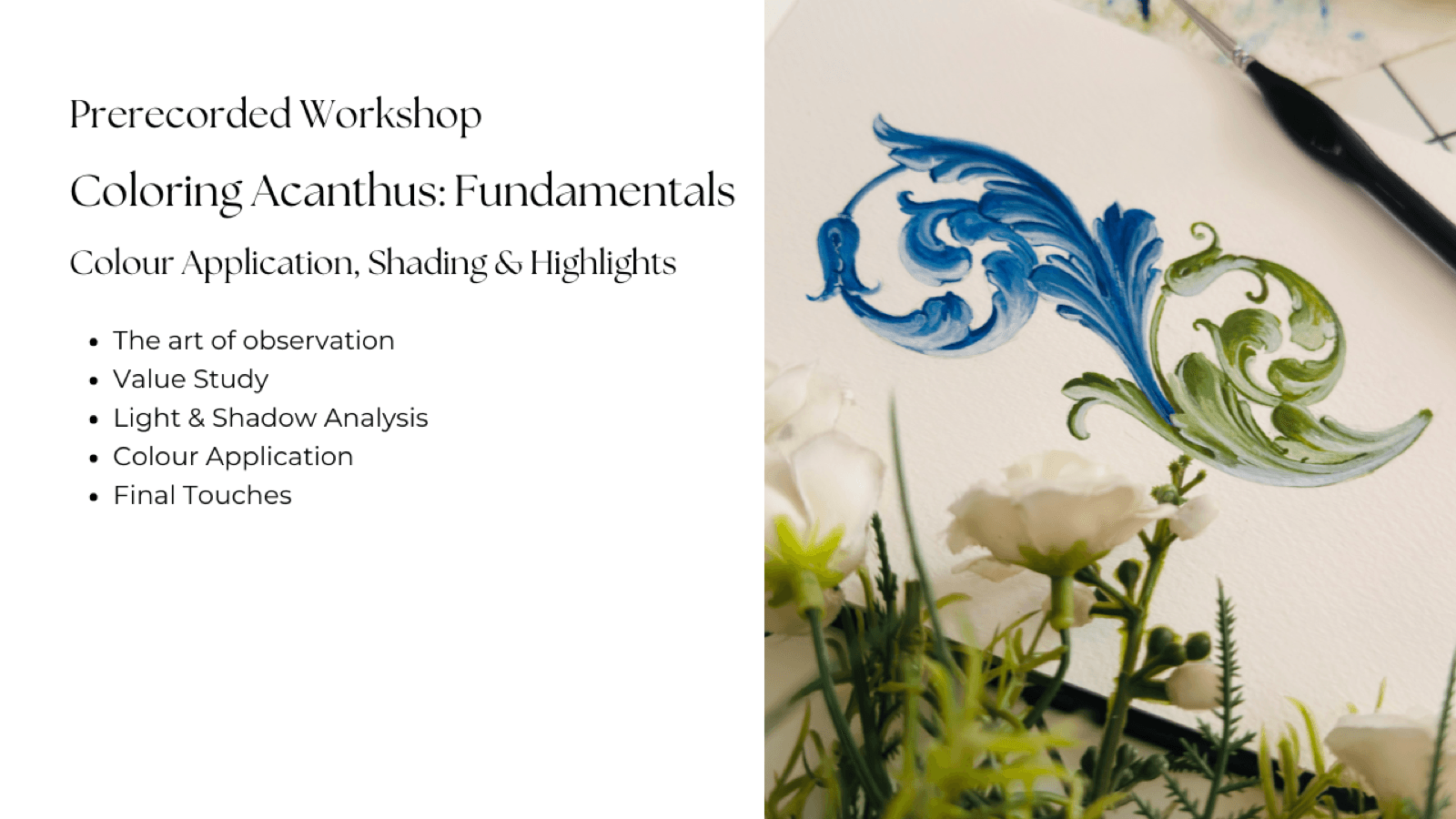
Colouring Acanthus: Fundamentals
Learn to read a reference, understand light and value, then colour an acanthus scroll in harmonious blues and greens.
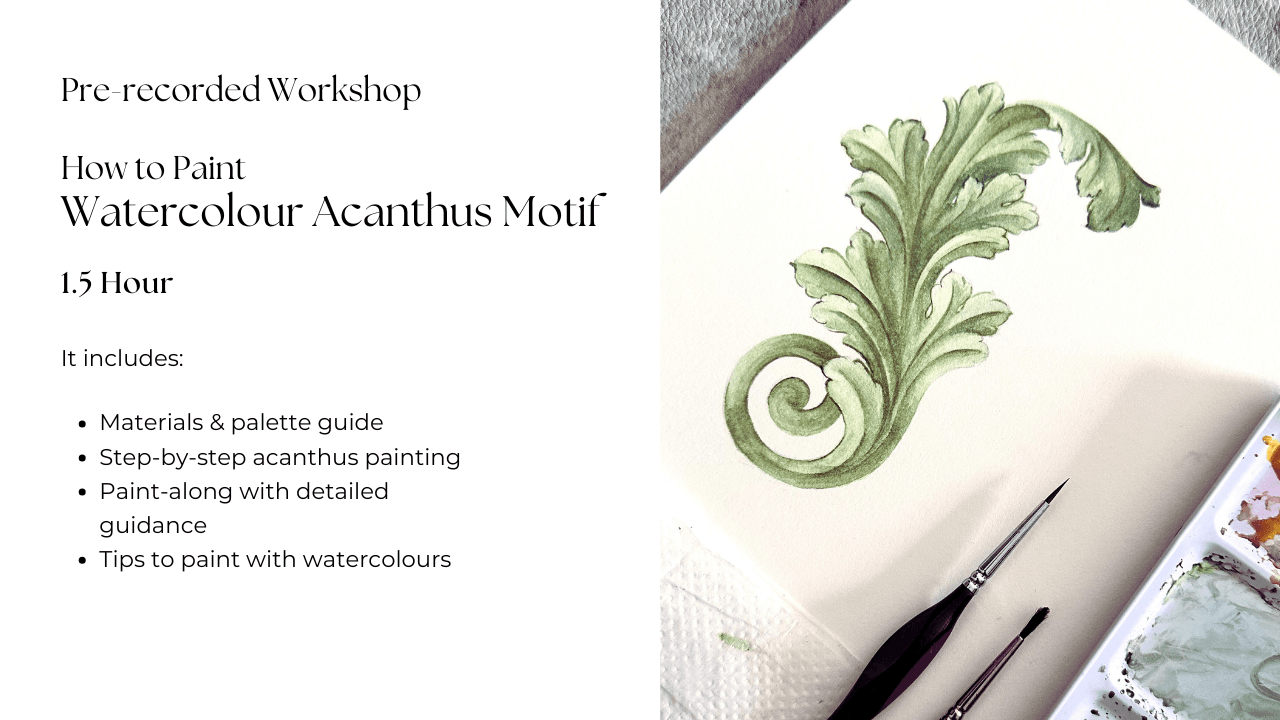
Watercolour Acanthus Motif
Learn to paint a classical acanthus motif in watercolour. This workshop focuses on palette, washes, shape control and the final details that make the motif feel dimensional.
Guides on the journal
You do not have to buy anything to start. These are free and in writing, and nobody asks you for an email address first.
How to Draw Acanthus Leaves, Step by Step
The acanthus leaf sits underneath nearly every piece of classical ornament. Here is how I build one in six steps, from the first pencil curve to the last line of ink.
A Beginner's Guide to Ornamental Art
Ornamental art is built from rules and rhythms rather than reference photos, which makes it a lovely place for a beginner to start. Here is what it actually is, which motifs to learn first, and the few materials you genuinely need.
Pen and Ink Shading Techniques for Botanical Art
Ink gives you no grey to mix, so every tone in a botanical drawing is built from marks. Here are the five shading techniques I use in every piece, and a simple leaf exercise to learn them.
Or take them with a membership
The OB Art Circle covers 18courses, the ones marked "In the membership" above among them, along with the live workshops and their replays, and the members' room where I look at work in progress. It starts at ₹1,100 a month and you can stop it whenever you like. If you would rather own one course outright, buy it once and it stays yours.