How to draw C scrolls and S scrolls
A scroll in ornament is not a curl of paper with a ribbon on it. It is a volute: a coil growing out of a stem, its band swelling and thinning as it turns. It runs underneath an acanthus leaf, it is the unit a border repeats, and the same shape turns up in engraved plates, in carved panels and in printed borders. Learn the C scroll and the S scroll properly and you have the skeleton that every ornamental composition hangs on.
Which course teaches which stage
I have written the step by step out in full here, free, from ruling the first box to hiding a join: How to Draw a C Scroll and an S Scroll in Ornamental Art. Read that if you want to draw one this afternoon. This page is for the other question.
The other question is which of these to actually buy, and in what order, and what you will be able to draw when you finish it. Four courses is not many, but they are not four versions of the same lesson, and taking them in the wrong order wastes the ones that assume a steady curve.
How to Draw a C Scroll: Scrollwork Course (1h 22m) is the one to take first, and it is the only one of the four I would call compulsory. It is a recorded live session, so you watch the whole thing get made rather than a tidied version of it. By the end you can lay out a spiral at the size and character you intended, keep the coil open where it should be open, and ink it without the centre giving up. Everything after this assumes you can do that.
How to Draw an S Scroll: Scrollwork Course (1h 10m) is shorter, because it is one idea worked through properly: balance. A C scroll you can get right by being careful. An S scroll you can only get right by judging it, and that is what the session trains. After it you can draw a scroll that moves rather than one that merely sits still and looks symmetrical.
Connecting Scrolls: Flow & Rhythm (1h 29m) is where you stop drawing scrolls and start drawing a design. Several curves, arranged so a viewer's eye travels the whole way through without snagging, is a separate skill from drawing any one of them, and it is the skill most people skip. Bring a compass or a circular guide to this one; the others need no such thing.
How to Draw Scroll Connectors: Knots and Ties (52m) is the shortest of the four and, for the time it asks of you, the one that changes a drawing most. Five joins built up step by step, knots and ties and a rosette tie, so that the places where two parts of your design meet stop being the weakest thing in it. Take it whenever the joins start bothering you.
All four together come to 4h 53m, and there is no rush about it. One course, then a fortnight of drawing, then the next, is better than four in a week.
What you need, and what the free one gives you
The kit is short and you probably have it. A pencil, a soft eraser, a fineliner, a ruler and smooth paper cover all four courses, plus a compass or a circular guide for Connecting Scrolls. Nothing here wants a tablet, a stylus or a piece of software, and nothing wants a brand.
The difference between the free tutorial and a course is not that one holds something back. The tutorial is the method in writing, and it is genuinely enough to draw a good C scroll from. A course is me drawing at the speed I actually draw, with the hesitations and the corrections left in, which is the part writing cannot carry. Each one also comes with files to download and work over, a manual or the sheets from the session.
The first two ask for no scroll experience whatsoever, so if you have never drawn one, start at the top and pay no attention to the level on the card. Connecting Scrolls would like you to have some curve practice behind you, and Connectors assumes you can already draw a simple scroll. What all four want is patience: the early ones you draw will be poor, that is simply what learning a curve looks like, and it turns enjoyable sooner than you expect.
The scrollwork courses
In that same order, with what each one costs and how long it runs. Every course is self paced, yours for good once bought, and watched in your browser whenever it suits you.
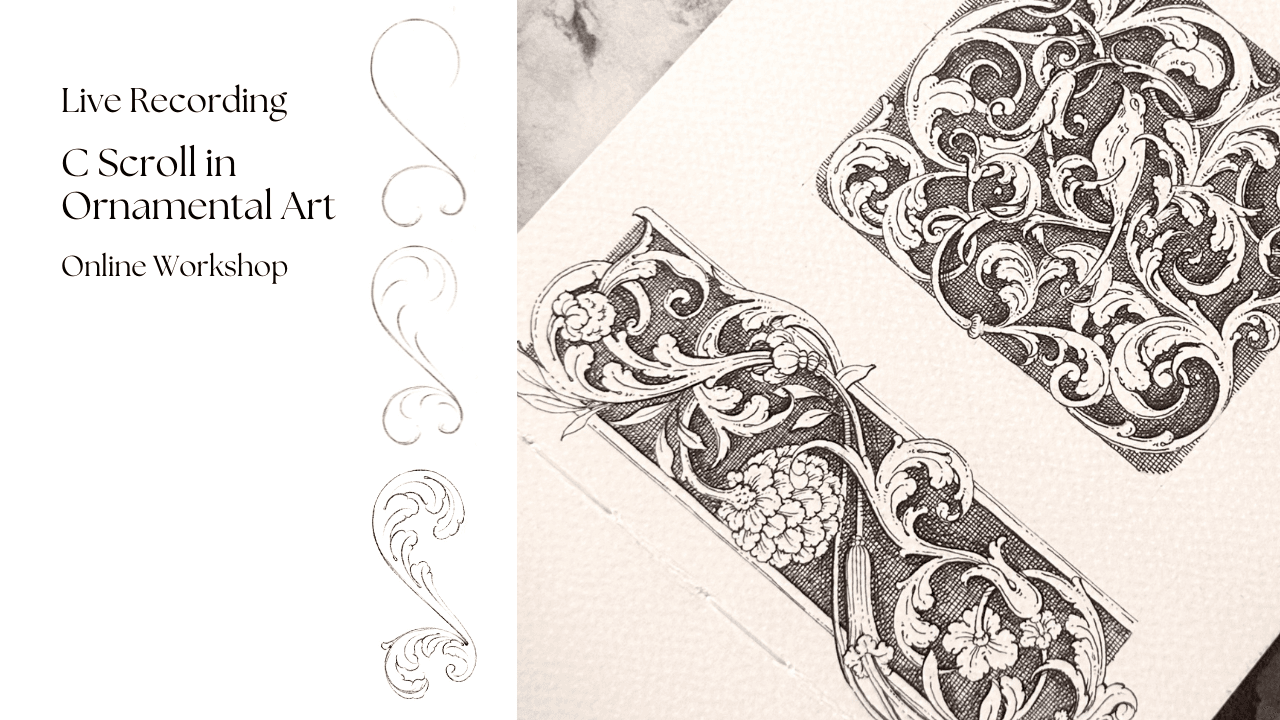
How to Draw a C Scroll: Scrollwork Course
Learn how to construct elegant C scrolls for ornamental art. This workshop covers grid-based spirals, curve control, overlapping forms, floral details and inking.
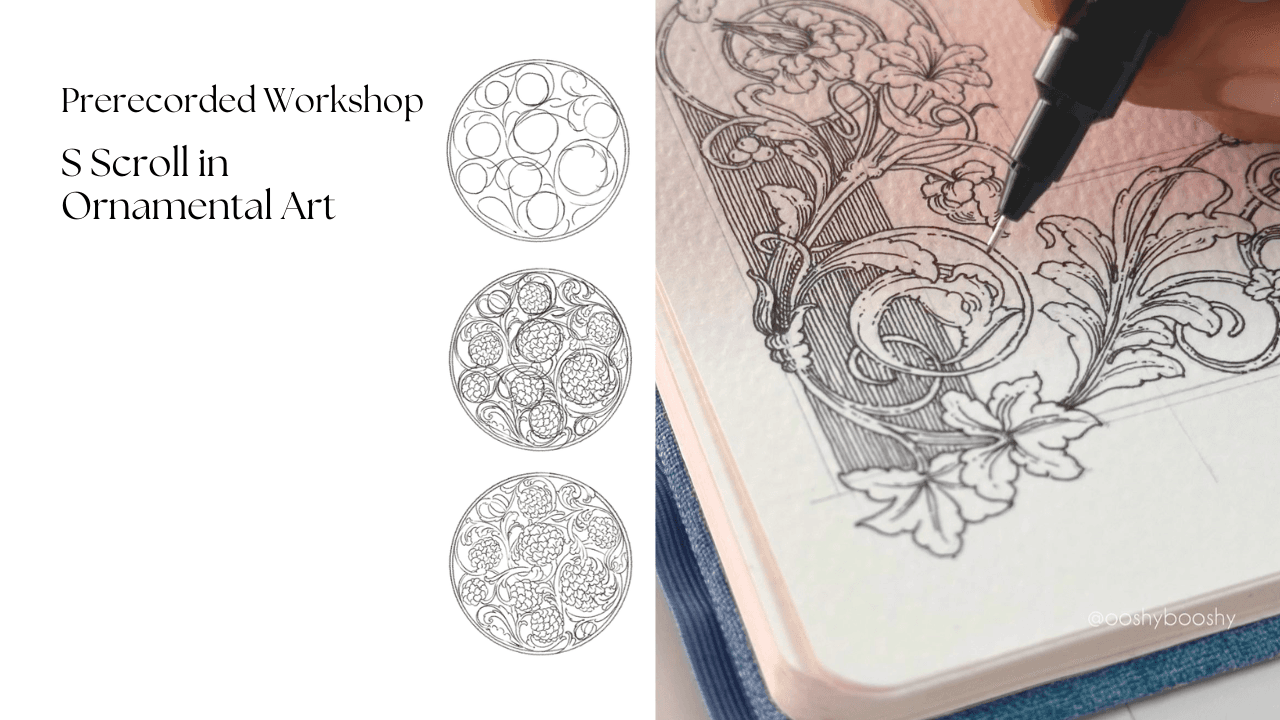
How to Draw an S Scroll: Scrollwork Course
Learn how to construct flowing S scrolls for ornamental art. This workshop explains movement, balance, guiding lines, curve control and scroll variations.
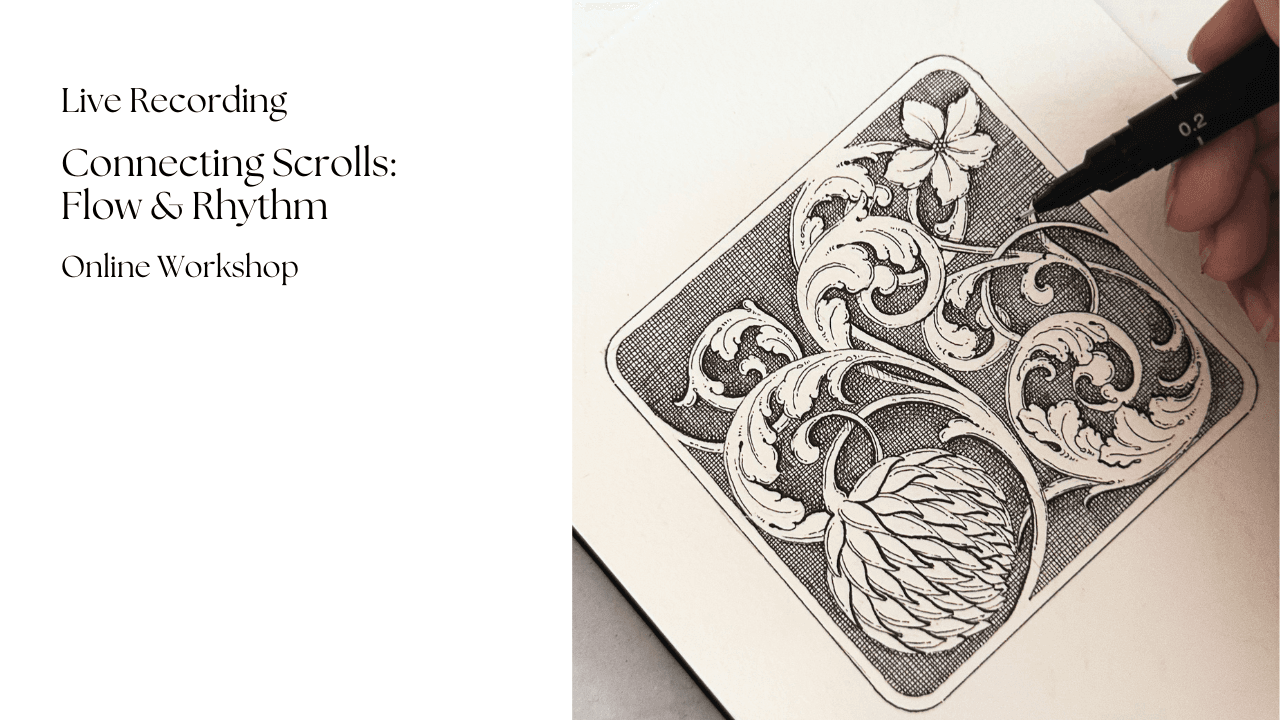
Connecting Scrolls: Flow & Rhythm
Learn how scrolls connect inside a complete ornamental composition. This workshop covers C scrolls, S scrolls, overlap, negative space, focal points, acanthus detail and inking.

How to Draw Scroll Connectors: Knots and Ties
Learn to design the join. Five connectors, built step by step, so a composition reads as one grown thing rather than parts pushed together.
Where scrolls go next
Once a scroll holds its shape, the work becomes composition. These two are the natural next step, they are both a good deal longer than anything above, and both are built almost entirely from the curves in them.
- Decorative Border Design Course: Corners and Repeats · intermediate · 4h 28m
- Cartouche Design Course: Draw an Ornamental Frame · intermediate · 6h 3m
Tutorials on the journal
You do not have to buy anything to start. These are free and in writing, and nobody asks you for an email address first.
How to Draw a C Scroll and an S Scroll in Ornamental Art
Rule a box, draw the eye of the spiral before anything else, then let the band thicken at the shoulder and taper back into the eye. That is a C scroll. Two of them on one spine, curving opposite ways, make an S. The full method, the joins, and what usually goes wrong.
A Beginner's Guide to Ornamental Art
Ornamental art is built from rules and rhythms rather than reference photos, which makes it a lovely place for a beginner to start. Here is what it actually is, which motifs to learn first, and the few materials you genuinely need.
How to Draw Straight, Confident Lines: Six Warm-Up Drills
Shaky ink lines are a movement habit, not a lack of talent. These are the warm-up drills I use to steady my hand before inking, with exact reps and a ten minute routine.
Or take them with a membership
The OB Art Circle covers 18courses, the ones marked "In the membership" above among them, along with the live workshops and their replays, and the members' room where I look at work in progress. It starts at ₹1,100 a month and you can stop it whenever you like. If you would rather own one course outright, buy it once and it stays yours.