How to Draw a C Scroll and an S Scroll in Ornamental Art
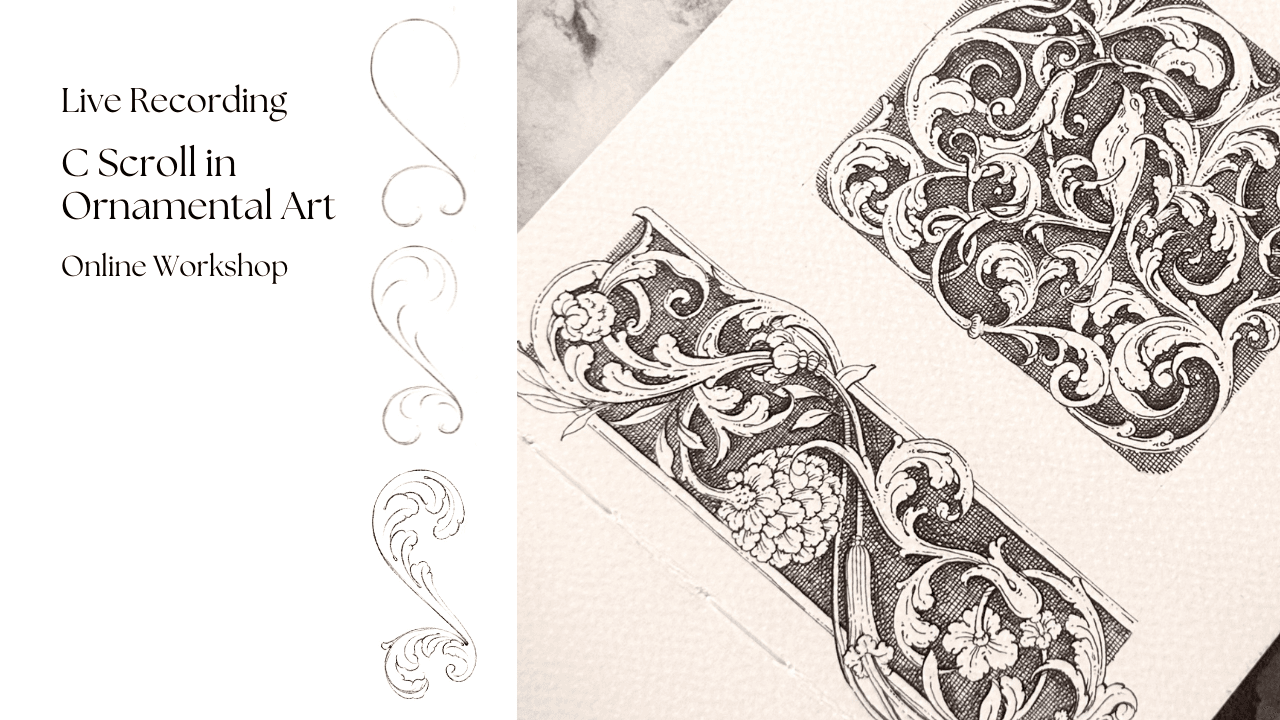
A C scroll is drawn from the inside out. Rule a box, draw the eye of the spiral first, work the spine outwards in light dots, then give that spine a body, fat at the shoulder and tapering back into the eye. An S scroll is two of those on one spine, curving opposite ways, a big eye at one end and a small one at the other. The shape is the volute, the spiral that springs from a stem: the bone under an acanthus leaf, and what a border repeats. If you came here for a curled paper edge with a ribbon, this is not that drawing. In the acanthus tradition, everything hangs off those two. Ornament is grown, not invented shape by shape.
What follows is the method: the box, the eye, the taper, how a C becomes an S, and how scrolls join. You need little. Smooth cartridge or bristol, 150gsm or heavier, to survive the rubbing out. A sharp pencil (HB or 2H), a ruler, a soft eraser, one fineliner around 0.3. Give it forty minutes and expect the first six scrolls to be poor, because that is the shape of learning this.
How to draw a C scroll, step by step
Step 1: Rule the box the scroll will live in
Draw a rectangle 6cm by 3.5cm, lightly, and halve it both ways with two faint lines. Mark a 1cm square in the right-hand third, just above the horizontal halving line: the house the eye sits in. The scroll grows from the lower left corner, crosses the vertical halving line two thirds up, and turns clockwise into that square.
The box decides the scroll's character before you draw a curve. Wide and shallow gives a lazy, open scroll, the kind that runs along a border for a foot without tiring. Tall and narrow gives tension. Rule three and feel it.
Step 2: Draw the eye first, and draw it small
Start on the lower left of the eye square, where the rising spine will arrive, and turn the pencil clockwise one and a half times, each gap smaller than the last, until the line closes on a dot no bigger than a pinhead. Turn the paper, not your hand. Wound the other way, a scroll is the same drawing mirrored.
This tiny thing governs everything outside it: a small square gives a tight coiled spiral, a large square an open one. Almost every failed scroll I am shown failed here, because the outer sweep went down first and the room ran out coming in. You get a blunt blob.
Step 3: Lay the spine as dots, correct the dots, then join them
Work outwards from the eye. Put down five to seven dots along the middle of the band's path, spaced wider as you leave the centre, out to the lower left corner where the scroll begins. Sit back. Move any dot that sits wrong, join them faintly, then firm up.
For the long sweep, draw from the shoulder and the elbow, not the fingers and the wrist. A curve drawn from the wrist has the radius of a wrist, so it arrives as a chain of small arcs with corners. The eye is the exception, small enough for the fingers.
Step 4: Give the spine a body, fat at the shoulder, thinning to the eye
So far you have a centre line. Draw a contour each side of it, widest at the shoulder, 4mm or 5mm apart in a box this size, converging as the band winds inwards. At the eye square the contours meet and close into the outermost turn of the coil. Inside that the eye stays a single line, so the centre reads as a tight button.
The two contours are never parallel. A band of even thickness reads as rope lying in a coil, inert. A tapering band reads as something that grew. If yours looks like rope, that is a growth error, not a drawing error.
A studio note: before any ornamental work I fill half a page with loose spirals, same size, same direction, until the hand stops arguing. It costs five minutes, and a warm scroll differs from a cold one in a way you see across the room.
Step 5: Ink it, then leave the pencil alone
Ink both contours in long strokes, from the fat shoulder towards the eye, then round the coil. A fineliner is monoline, so weight comes from repetition, not pressure: run a second pass and a third along the shoulder end, each stopping shorter than the last. The spine was construction. It goes with the grid.
Give the ink several minutes, longer than you want to. Test the eraser on a stray stroke at the sheet's edge, then lift the grid in one direction, not scrubbing. Tracing over pencil in small nervous movements gives a furry line nothing will save. An ink stroke is a decision and should look like one.
How to draw an S scroll
Step 6: Two C scrolls on one spine, eyes on opposite sides
An S scroll is two C scrolls of unequal size on one spine, curving opposite ways and meeting at the inflection. Rule a box twice as long as the C box and a little taller, 12cm by 4.5cm, the large eye square high on the left and the small one low on the right, so the spine crosses the long centre line once. Run it from big eye to small without lifting the pencil, then give it a body, fattest where the lobes hand over.
The eyes must sit on opposite sides of that centre line. Put them on the same side and you get a wave, or a lumpy C. Place the crossing off centre too, two thirds along, nearer the smaller eye. Matching halves with the crossover in the middle read as a symmetry exercise: a shape, not a movement.
How to join scrolls so the flow passes along
Step 7: Grow each new scroll out of the one before
Draw one full scroll. Mark a point on its back, halfway between shoulder and eye, and lay the first two dots of the new scroll along the parent's direction there rather than across it, so the child sets off on the tangent. Tuck its start behind the parent's contour so the join is hidden.
Test it with your finger. Trace the design: wherever your finger hesitates or turns a corner, the join is wrong. Two more rules: nothing starts in mid-air, so every scroll leaves a stem, a leaf sheath or another scroll; and scrolls diminish outwards, a child smaller than its parent. Direction is a judgement, not a law: opposing curves balance a pair, a running border more often repeats one direction.
Step 8: Fill a page with spines before you draw a single leaf
Follow the progression in order. A whole page of spines only: boxes, eyes, dots, spine, taper, nothing else. Second page, the same scrolls with one leaf off each shoulder, springing from the outer contour and turning the way the scroll turns. Third, the same in ink.
Everyone wants leaves on day one, and leaves on a collapsed spiral are lipstick on a broken line. Thirty spines is not one sitting: at six minutes each that is three hours, so spread it across a week. If the leaf itself defeats you, the fundamentals of the acanthus leaf is a study of its own.
Common mistakes, and how to fix them
- The spiral goes flat and the centre ends as a blunt blob. Draw the eye first in its own square, starting where the spine will arrive, gaps shrinking each round, then build the rest to meet it.
- The two contours run parallel and the scroll reads as rope. Widen the shoulder and let the contours converge as the band travels inwards. Squint: if it looks the same width at both ends, it is not tapered enough.
- The S has two matching halves. Move the inflection to two thirds along and make one eye clearly smaller. Equal halves read as symmetry, and symmetry sits still, the opposite of what an S is for.
- The scroll starts in mid-air. Tuck its beginning behind a stem, a leaf or a larger scroll's shoulder so it has an origin, and set it off on the tangent. Then check its winding: opposing curves for a balanced pair, one repeated direction for a running border, never one at random.
Where to take it next
The workshops this comes from go further than a post can. The C scroll in ornamental art is a recorded live session: grids and geometry for accurate spirals, scroll variations, combinations in the same and reverse directions, overlap for depth, then inking and shading. The S scroll in ornamental art is its companion: the basic S curve, grids and guiding lines, variations, and how S scrolls combine in a composition.
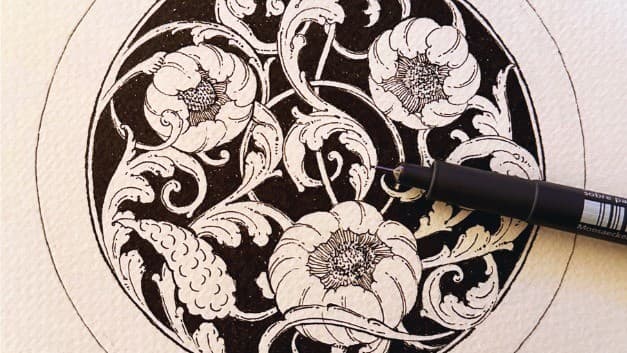
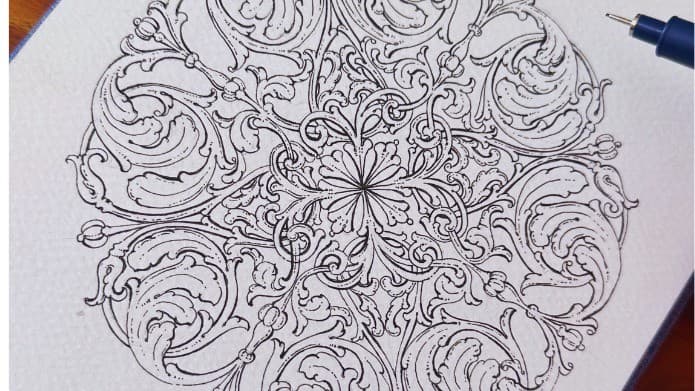
When single scrolls stop being the problem, arrangement becomes the problem. Connecting scrolls, flow and rhythm builds a whole composition inside a 9cm square, using margins and circular grids, and covers overlap, focal points, negative space, and how acanthus follows a scroll. Bring a compass to that one. All three sit inside the OB Art Circle, alongside the acanthus and border courses these scrolls feed into.
A few questions I often get
What is the difference between a C scroll and an S scroll?
A C scroll is one curve winding into one eye, like the letter C with its end rolled in. An S scroll is two of those back to back on one spine, with an inflection where the curve reverses. The halves are never equal: the larger reads as the source, the smaller as the reply. You will use far more C scrolls than S scrolls.
Do I need a compass or dividers to draw ornamental scrolls?
Not for the spiral itself. A compass draws arcs of fixed radius, so a spiral built from them increases mechanically, right for an architectural volute and wrong for a growing one. Draw the eye and the sweep freehand inside a ruled box. A compass earns its place later, laying out a composition: circular grids keep a border honest, and the connecting scrolls workshop asks for one.
How long does it take to get good at drawing scrolls?
Longer than a weekend, shorter than you fear. You have a great many bad scrolls in you and the sooner you draw them the better, a cheerful thought once you stop resisting it. Twenty minutes a day of spines only, no leaves, and the curve steadies in a few weeks. The taper takes longer to feel. Placing a scroll well takes longest of all.
Comments
Loading…